

Reusable Plastic vs Cardboard Moving Boxes for Students | Relocrate
If you’re a UK student (or a parent) planning a university move, this guide compares reusable plastic moving boxes and traditional cardboard so you can save time, money, and reduce waste. You will learn what reusable moving boxes are, how they protect belongings, the upsides and downsides of cardboard, and practical packing and transport tips tailored to student life. The article evaluates cost and environmental impact, provides packing checklists for common student items, and explains how a rental model can change the economics of termly moves. Throughout, we use the lens of student accommodation constraints—small rooms, shared corridors, and tight move-in windows—to keep recommendations practical. The comparison uses semantic categories like durability, stackability, lifecycle waste, and rental convenience so you can decide whether reusable crates or cardboard boxes suit your needs. Read on for step-by-step packing workflows, quick feature lists, and guidance on renting reusable kits where available.
What Are Reusable Moving Boxes and How Do They Benefit University Students?
Reusable moving boxes are durable plastic moving crates designed for repeated use, typically featuring stackable bases, secure lids, and integrated handles that simplify lifts and transport. Their mechanism—rigid, water-resistant plastic combined with uniform dimensions—reduces packing time because crates need no assembly and stack neatly in vans and small rooms. Students benefit because these crates protect heavy textbooks and electronics from crushing and damp, save floor space in cramped halls, and eliminate the need to source and then dispose of used cardboard. Reusable crates also reduce the time spent taping and labelling because standardised sizes and clip lids streamline handling. This efficiency directly translates into fewer trips, less stress on move days, and reduced waste compared with disposable alternatives, setting up the next discussion about the specific features that make plastic crates ideal for student moves.
Reusable moving boxes offer three core advantages for students:
- Durability and protection: Plastic resists crushing and water, safeguarding books and electronics.
- Eco-friendly reuse: Repeated cycles cut single-use waste over the academic year.
- Convenience: No assembly or tape needed; stackable designs save space and time.
What Features Make Plastic Moving Crates Ideal for Student Moves?
Plastic moving crates commonly include uniform dimensions, ergonomic hand-holds, secure lids, and stackability, which together make them efficient in narrow corridors and shared lifts. The uniform sizing means crates stack predictably, so students can maximise under-bed or wardrobe storage and fit many modules into a single van load. Because the material is water-resistant and has a rigid wall structure, crates protect textbooks and electronics on rainy UK move days and resist crushing when stacked several layers high. An everyday example: a student using stackable crates reduced van trips by filling vertical space rather than using irregular cardboard boxes, saving time during a busy move-in slot. These operational advantages reduce handling time and the risk of damage, and they naturally lead to considering ready-made kit solutions aimed at students.
How Do Relocrate's Essential Kits Simplify Moving for UK Students?
Relocrate provides eco-friendly, reusable plastic moving crates for rent, and a hypothetical “essential kits” offering for university students that maps crate counts to typical student inventories while including delivery and pickup services. The kit concept packages a curated set of stackable crates sized for common student items—books, kitchenware, clothing—and is intended to arrive ready to use at halls, removing the need for assembly or tape. Delivery and pickup services mean students can schedule drop-off at their accommodation and return crates at term end, which eliminates disposal chores and storage headaches. This rental workflow saves time during tight move-in windows, and the uniform crates simplify labelling and stacking, making unpacking faster. Presenting the essential kit as an optional, convenient solution helps students weigh renting crates against sourcing cardboard locally.
What Are the Advantages and Disadvantages of Cardboard Moving Boxes for Students?
Cardboard moving boxes are inexpensive and widely available, making them an obvious first choice for many students who need an immediate packing solution. Cardboard’s mechanism—single-use corrugated layers—offers light-weight protection and easy flattening for transport, which makes it simple to store after a move or recycle. The advantage for students is the low upfront cost and the ability to source boxes locally from supermarkets or online retailers, which is useful for last-minute moves. However, cardboard has clear downsides: it deteriorates in wet conditions, compresses under heavy loads like textbooks, and requires time-consuming assembly and taping. These weaknesses often turn a cheap initial purchase into recurring time and replacement costs across terms, and the next paragraphs break down the cost and convenience benefits and the practical challenges students face.
Cardboard has straightforward pros and cons for student moves:
- Pros:Low initial purchase price and easy sourcing.Lightweight and easy to carry when empty.Simple to recycle after use.
- Cons:Vulnerable to moisture and crushing.Requires tape, assembly, and disposal time.Replacement is often needed for repeated termly moves.
What Are the Cost and Convenience Benefits of Cardboard Boxes?
Cardboard’s appeal is its immediate affordability and ubiquity: students can acquire boxes quickly from local shops or online, and the disposable nature avoids storage logistics between terms. Because cardboard arrives flat, it occupies minimal space until assembled, which is helpful in small student rooms, and its light weight makes carrying multiple boxes easier on short staircases. Recycling infrastructure in many UK university towns allows straightforward disposal, keeping the end-of-term clean-up manageable in most cases. However, convenience costs appear in the form of tape, markers, replacements, and time spent assembling and reinforcing boxes before a move. Understanding these trade-offs helps students decide whether the short-term savings outweigh the cumulative effort and replacement costs across multiple moves.
What Challenges Do Students Face When Using Cardboard Boxes?
Students frequently encounter cardboard failures during rainy move days, with soaked boxes losing rigidity and putting contents at risk—especially heavy textbooks and electronics. Heavy loads compress corrugated walls, causing boxes to bow or collapse in transit unless double-boxed or reinforced with tape, which increases material and time costs. Cardboard also attracts pests in long-term storage and can require multiple purchases if boxes are left at halls or damaged, which adds hidden expenses over the academic year. Finally, disposal and recycling take time—collecting, flattening, and carrying boxes to recycling points on busy move-out days is an added chore. These practical pain points point toward a cost and environmental comparison that weighs upfront savings against lifecycle costs.
How Do Reusable Moving Boxes Compare to Cardboard in Cost and Environmental Impact?
Reusable plastic moving boxes and cardboard diverge sharply when viewed across lifecycle cost and environmental impact: cardboard has low upfront cost but higher recurring purchase and disposal costs, while reusable crates require a rental or purchase decision up front but eliminate repeated buying and reduce single-use waste. The mechanism behind environmental gains is reuse cycles—each crate used multiple times displaces many single-use boxes, reducing landfill input and the energy of repeated manufacturing. From an economic perspective for students who move termly, the time saved on assembly, tape, and disposal also factors as an economic benefit. The table below summarises cost, environmental impact, and convenience, making it easy to compare the two approaches.
| Packaging Option | Cost Profile | Waste & Environmental Impact | Convenience |
|---|---|---|---|
| Reusable plastic crates | Rental or one-off purchase model; avoids repeat buys and tape costs | Lower single-use waste; fewer disposal cycles; reduced landfill contribution | No assembly, standardised stacking, delivery/pickup options |
| Cardboard boxes | Low upfront purchase; repeated buys for multiple moves; tape and reinforcement costs | Significant single-use waste; frequent recycling/disposal required | Requires assembly, tape, storage, and recycling logistics |
What Is the Long-Term Cost Comparison for Renting vs. Buying Moving Boxes?
When evaluating repeated moves across an academic year, renting reusable crates changes the cost formula by converting recurring purchase and disposal tasks into a single rental workflow that includes delivery and pickup. The mechanism here is substitution: renting replaces multiple cardboard purchases, tape, and disposal trips with scheduled deliveries and returns, reducing both time costs and recurring material purchases. For students who move every term or frequently transport belongings between term-time and home, renting can eliminate the cumulative labour of assembly and recycling even if the rental appears higher in a single-use comparison. Because specific prices are not provided here, focus on the rental model benefits—no tape, no disposal, standard sizing—and how those operational savings can add up in student budget scenarios over multiple moves.
| Item | Cardboard (Repeated) | Reusable Crate (Rental Model) |
|---|---|---|
| Upfront cost per move | Low (boxes + tape) | None per move (rental converts to short-term fee) |
| Recurring replacement | Often required | Not required (designed for reuse) |
| Time cost | High (assembly, disposal) | Low (no assembly, pickup arranged) |
How Do Plastic Crates Reduce Environmental Waste Compared to Cardboard?
Plastic crates reduce environmental waste primarily through repeat usage: each crate can replace many single-use cardboard boxes over its service life, cutting the volume of material entering recycling or landfill streams. The lifecycle mechanism involves fewer manufacturing cycles per unit of transported goods because a durable crate persists across moves rather than being manufactured, used once, and disposed of. This reduction in single-use consumption also decreases the logistics footprint associated with waste collection and recycling. For students, repeated use across terms yields per-person waste reductions that accumulate when many students adopt reusable kits, and recent studies in packaging lifecycle analysis show reuse models typically outperform single-use options on landfill and resource metrics. These sustainability advantages pair with cost and protection benefits, prompting a deeper look at how crates protect belongings.
How Do Reusable Moving Boxes Protect Student Belongings Better Than Cardboard?
Reusable crates afford superior protection for common student items by combining rigid sides, secure lids, and stack-stable designs that limit pressure points and water ingress. The protective mechanism is structural rigidity: crates maintain shape under load, preventing crushing of heavy items like textbooks and reducing movement that can damage electronics. Their water-resistant material prevents moisture wicking, an important advantage during damp UK move days or when items are temporarily stored in basements or shared storage. Consistent crate sizing also simplifies padding and placement of fragile items, improving handling safety. These protective characteristics lead into a technical comparison of durability, weather resistance, and practical packing advice for students.
| Item Category | Protection Need | Typical Crate Advantage |
|---|---|---|
| Electronics | Water & crush resistance | Rigid sides, raised base, secure lids |
| Textbooks | High weight-bearing capacity | Stackable strength, minimal bowing |
| Clothes & soft goods | Dry storage, compact stacking | Clean, easy-to-seal environment |
What Durability and Weather Resistance Do Plastic Crates Offer?
Plastic crates are made from durable polymers designed to resist impact, moisture, and deformation, meaning they maintain structural integrity during repeated stacking and transport. The material resists water absorption, so rain or damp storage conditions are less likely to compromise contents than with corrugated cardboard. Crates can withstand typical student handling—multiple lifts, van transit, and temporary storage—without the rippling, bowing, or collapse that can afflict cardboard under heavy textbook loads. Cleaning and drying are straightforward, allowing crates to be hygienically reused between occupants. Understanding these durability advantages helps students pack smarter and plan transport that reduces damage risk during busy move-in and move-out windows.
How Do Plastic Boxes Safeguard Electronics, Books, and Clothes?
For electronics, rigid crate sides and raised bases limit water exposure and shock transfer, and the uniform interior space makes it easier to add padding or separate accessories. Heavy textbooks benefit from even load distribution across flat crate surfaces, reducing localized crushing and making stacking safe in vans or storage spaces. Clothes remain dry and can be stored without compression wrinkles if crates are not over-packed, and lids protect against dust and moisture, unlike open or damaged cardboard. The consistent crate dimensions also make labelling and organization easier, which reduces rough handling and speeds unpacking—advantages that support efficient move-in and easy transition into the next section on packing and moving tips.
What Packing and Moving Tips Help Students Maximize Reusable Moving Boxes?

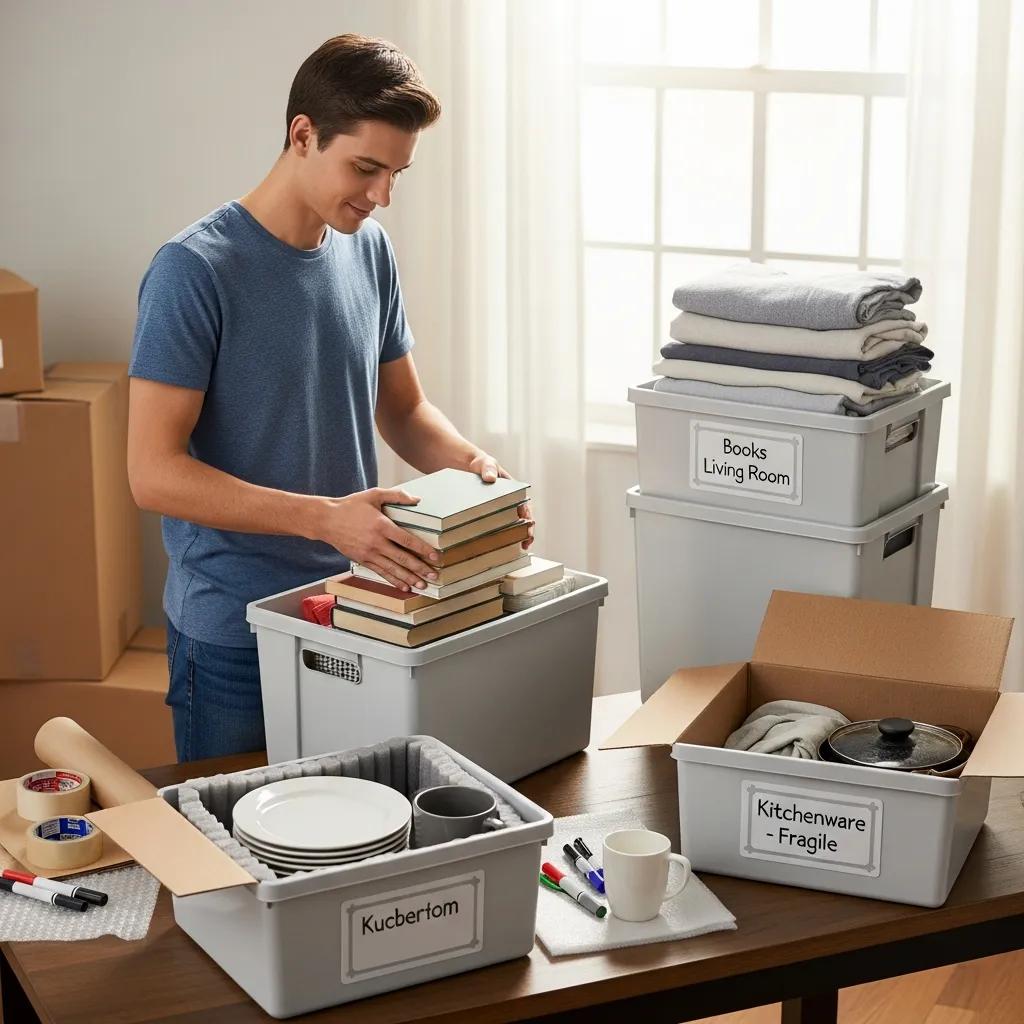
Using reusable crates effectively requires a few simple packing strategies that prioritise weight distribution, item grouping, and label clarity to exploit crate strengths. Begin by placing heavy items—textbooks, small appliances—into lower crates and reserve smaller, easier-to-lift crates for fragile or frequently needed items. Group items by room or priority so that crates labelled “desk” or “kitchen” go directly to their destination, cutting unpacking time. Transport considerations include securing lids during van transit and using dollies or trolleys where available to reduce trips and physical strain. These practical methods improve crate efficiency and lead naturally into a recommended kit composition that maps crate sizes to common student inventories.
Below is a concise packing checklist that students can follow before move day.
- Pack heavy items low: Place textbooks and appliances in lower crates to stabilise stacks.
- Group by room: Label each crate with the target room for faster unloading.
- Protect fragile items: Use soft clothing or bubble wrap inside smaller crates for electronics.
- Secure lids and straps: Ensure lids are clipped and stacks are stable for transit.
| Crate Size | Recommended Contents | Suggested Quantity |
|---|---|---|
| Large | Textbooks, kitchen appliances | 4–6 |
| Medium | Clothes, toiletries, bedding | 3–5 |
| Small | Electronics, stationery, fragile items | 2–4 |
How Can Students Efficiently Pack Using Relocrate's Essential Kits?
Assuming use of an essential kit model, start by unpacking the kit contents and assigning crates to rooms immediately as they arrive—one for bedding, one for kitchen, one for study items—and keeping a small crate for daily essentials. Pack heavy items lower and fill gaps with soft items to prevent shifting; electronics should be wrapped and cushioned in smaller crates. Label each crate clearly by room and a short content list to speed unloading and coordinate with flatmates or parents on move day. When finished, schedule the pickup window (if using a rental solution) so crates are returned without storage headaches; this streamlines the end-of-term routine and minimises disposal chores that cardboard entails.
What Are Best Practices for Transport and Storage in University Accommodation?
Before moving, measure key access points—doorways, elevator dimensions, and stair widths—to confirm stack height and crate configurations will pass through without obstruction. When transporting crates through halls, keep stacks to safe heights, secure lids, and use a trolley where available to reduce manual carrying. For short-term storage in halls, stacking under beds or in wardrobes keeps rooms tidy; for longer storage, ensure lids are clipped and crates are elevated from damp floors. Coordinate delivery and pickup times with residence staff and flatmates to avoid cluttered corridors, and always confirm building policies about stacked items in communal spaces. These best practices protect both your belongings and your relationship with accommodation managers, leading naturally to how students can access rental kits.
Where and How Can University Students Rent Relocrate's Essential Moving Kits?
Relocrate provides eco-friendly, reusable plastic moving crates for rent. According to available information, current operations are focused on the Metro-Denver area in the United States and include delivery and pickup services; any UK availability is hypothetical and should be confirmed directly with providers. The rental concept typically follows a simple workflow: order a kit tailored to student needs, schedule delivery to halls or an agreed pickup point, use the crates for move-in and move-out, and arrange for pickup at the end of the rental period. This navigation-oriented section outlines practical steps students should expect and highlights the distinction between the factual Metro-Denver operation and any planned or hypothetical UK roll-out.
Below is a quick step-by-step rental process students can expect when renting reusable kits.
- Select kit size and quantity: Choose a student-focused kit that maps to typical inventories.
- Schedule delivery: Pick a date and delivery location such as a hall of residence or local pick-up point.
- Pack and use: Fill crates during move-in, stack securely, and label clearly for fast unpacking.
- Arrange pickup: Book a return window at term end so crates are collected and removed.
Which UK Universities and Areas Does Relocrate Serve?
It is important to be transparent: Relocrate’s current operations reported in search analysis are focused on the Metro-Denver area in the United States and include delivery and pickup services there. Any statements about UK university coverage would be hypothetical; students in the UK should treat UK service mentions as planned or potential expansions rather than confirmed availability. Students should verify availability locally by checking providers that operate in their university town. This factual clarity ensures readers understand where rental services are active now and where they might expect future roll-outs.
What Are the Rental Process, Delivery, and Pickup Options?
Typical rental logistics allow students to place orders online, select delivery to halls or a nearby pickup hub, and book a pickup window for the end of term—options include scheduled weekday drops or specific weekend move-in slots depending on provider capacity. Delivery and pickup services reduce the need to store empty boxes between terms and remove disposal obligations, while scheduled windows help with building access limitations and busy move days. Students should prepare by labelling crates, securing lids, and ensuring someone is present for delivery or providing a safe alternative location. Confirm scheduling options directly with the provider, and remember that Metro-Denver service is reported as current; any UK roll-out should be verified before assuming availability.